
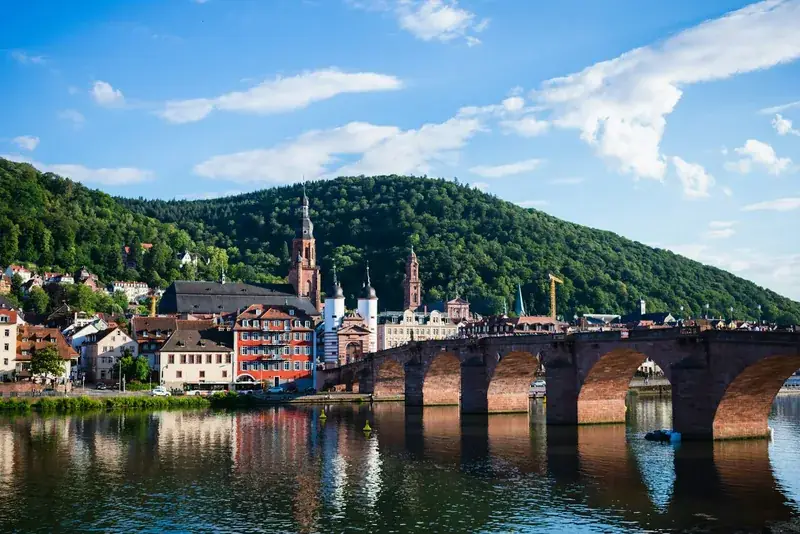

Heidelberg is the Germany that the Romantics painted: a red-sandstone castle ruin half-swallowed by the wooded Königstuhl, a baroque Old Town pressed into the narrow valley below, and the Neckar sliding past under a bridge of the same warm stone. It is also a university town through and through — Germany's oldest, founded in 1386, still fills the lanes with nearly 30,000 students — so the mood is young even where the buildings are not.
The city is compact enough to explore in a day or two, and nearly every corner has a story worth hearing. With self-guided audio guides you can let each landmark tell its own — why the castle was never rebuilt, what the bridge monkey is for, who really gave the Philosophers' Walk its name — and move at whatever pace the hills allow.
Start at Heidelberg Castle
Around a million people a year climb to Heidelberg Castle, the residence of the Palatine prince-electors until wars with France at the end of the seventeenth century left it a ruin that nobody rebuilt. That neglect turned out to be its fortune: since the early nineteenth century the shattered towers and the stone ancestor gallery on Friedrich's Wing have been synonymous with German Romanticism. Inside the courtyard, the Barrel Building shelters the Great Tun, a wine cask holding roughly 220,000 litres, and the German Pharmacy Museum traces centuries of apothecary craft in the castle's vaulted rooms. Each has its own audio guide, so the ruin reads as a sequence of chapters rather than a single photo stop.
Heidelberg Castle
Red sandstone palace ruin above the Neckar, blown up by French troops and adored by the Romantics.
Barrel Building
Castle cellar housing a colossal eighteenth-century oak wine cask topped by a dance floor.
German Pharmacy Museum
Historic apothecary interiors, painted cupboards and majolica jars in a Renaissance castle palace.
The Old Bridge and the Neckar
Below the castle, the Old Bridge — properly the Karl-Theodor-Brücke, built in 1788 under the elector whose name it carries — is the classic frame for the castle view. At the town gate sits the bronze Brückenaffe, a monkey holding a mirror and gesturing at his backside, a wry prompt to self-reflection; local lore says touching his finger brings you back to Heidelberg. Cross to the far bank and the Neckarwiese opens out, a long riverside lawn where the whole city seems to picnic and grill on warm evenings, with the castle glowing opposite.
Old Bridge Heidelberg
Baroque sandstone arch bridge over the Neckar, guarded by twin-towered medieval gate and statues.
Brückenaffe
Bronze baboon holding out a mirror by a medieval bridge gate, rubbed by visitors for luck.
Neckarwiese
Riverside floodplain lawn with poplars, playgrounds and wide views across the river to the old town.
Hauptstraße, Marktplatz and the Old University
The Old Town hangs off one spine: the Hauptstraße, about 1.6 kilometres of car-free street often called the longest pedestrian zone in Europe, running from Bismarckplatz to the triumphal-arch Karlstor that citizens gifted to Elector Karl Theodor at the eastern end. Midway, the Heidelberger Marktplatz — the oldest of the city's three squares — gathers around the Heiliggeistkirche, a church with thirteenth-century origins whose nave was split by a wall between Catholics and Protestants until 1936; 208 steps climb its tower to a platform over the rooftops. A few streets on, the Alte Universität and the Studentenkarzer tell the university's less dignified side: students who misbehaved, usually after drinking, served sentences from a few days to a few weeks in the jail and covered its walls with graffiti, silhouettes and boasts that survive today. The audio guides here are the ones to save for a slow afternoon.
Hauptstraße
Pedestrianised main street of the old town, lined with Baroque facades, taverns and shops.
Karlstor
Neoclassical triumphal arch honouring an 18th-century elector, with lions, coat of arms and royal portraits.
Heidelberger Marktplatz
Medieval market square with a Hercules fountain, framed by the town hall and a Gothic church.
Heiliggeistkirche
Gothic sandstone hall church with high double galleries that once held a famed Renaissance library.
Alte Universität
Baroque university hall rebuilt after war, with a ceremonial aula, museum and student prison behind.
Studentenkarzer
Former university jail whose five cells are covered in students' graffiti, portraits and verses.
Across the river on the Philosophers' Walk
From the Old Bridge, the steep, winding cobbles of the Schlangenweg climb the north bank to the Philosophenweg, a roughly two-kilometre terrace path laid out in its present form between 1837 and 1841 and walked by the poets Hölderlin and Eichendorff — though the name honours the students who came here to court and argue, not the famous thinkers. South-facing drystone walls trap enough heat for lizards, wild bees and medlar trees, and the views back to the castle are the best in town. Keep climbing the Heiligenberg and you reach the ruined Michaelskloster Heiligenberg, a medieval monastery, and the Thingstätte Heidelberg, an open-air amphitheatre for 20,000 built by the Nazis in the 1930s and now an unsettling, free-to-visit relic in the woods.
Schlangenweg
Steep cobbled zigzag stair between drystone walls, climbing from the river to a hillside promenade.
Philosophenweg
Hillside walking path above the river, with poets' memorials and sweeping views of the castle and old town.
Michaelskloster Heiligenberg
Romanesque basilica ruin on a wooded summit, with a crypt, climbable towers and a Roman temple beneath.
Thingstätte Heidelberg
Nazi-era open-air amphitheatre of stone terraces hidden in the forest atop a hill above the river.
Up the Königstuhl by funicular
The Heidelberger Bergbahnen leave from the Kornmarkt: the lower, modern section reaches the castle and Molkenkur in about two minutes, and the upper line — one of the oldest electrically operated mountain railways in Germany — carries on to the Königstuhl summit at 567 metres, around seventeen minutes in all. On a clear day the view runs past the Rhine plain to the Black Forest and the Vosges. It is the easiest way to see the whole valley at once before going back down to walk it.
Museums and quieter corners
When the weather turns, the Kurpfälzisches Museum fills a professors' residence of 1712 with the art and archaeology of the Palatinate; its prize is Tilman Riemenschneider's carved Windsheim Altar of the Twelve Apostles. Beyond that, the lanes between the Hauptstraße and the river hide the city's smaller churches, courtyards and student taverns, which are where the audio guides earn their keep.
Getting around
Heidelberg's main station sits west of the centre; trams and buses run to Bismarckplatz, and from there the Old Town is entirely walkable. Expect hills: the castle, the Philosophenweg and the Königstuhl all involve real climbs, so the funicular and a good pair of shoes are both worth having.