
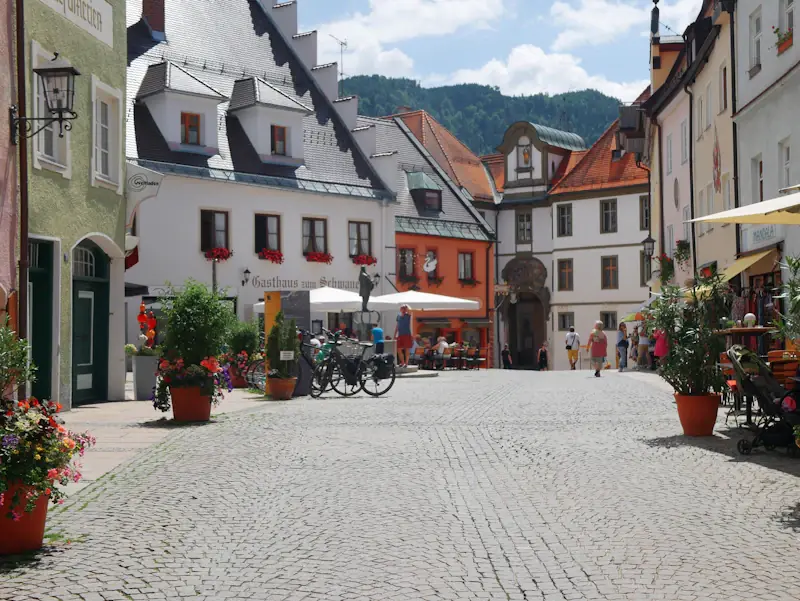

Füssen is the small Bavarian town where the Romantic Road runs out of road. It sits at 808 metres on the river Lech, a kilometre from the Austrian border, with the Ammergau Alps closing the horizon to the south and the Forggensee opening to the north. Most visitors come for the castle on the hill next door, but the town itself has a medieval old town, a prince-bishop's castle, a Benedictine abbey and a half-forgotten past as Europe's centre of lute and violin making.
It is also a place that rewards listening. The streets are short and the stories are long: Roman traders on the Via Claudia Augusta, Benedictine monks, an Augsburg bishop's summer court, a king who built a fairy tale and did not live to finish it. Each of the landmarks below has its own audio guide, so you can walk from the Füssen Altstadt up to the castles and the lakes at your own pace with the story in your ears.

The old town, the High Castle and St. Mang
Start in the Altstadt, where the painted gabled houses of Reichenstrasse climb towards the ridge. Above them stands the Hohes Schloss, one of Bavaria's best-preserved late-Gothic castles and once the summer residence of the prince-bishops of Augsburg; its courtyard façades are covered in trompe-l'oeil windows and oriels that fool the eye from a few metres away. Just below it is the Benediktinerkloster St. Mang, a Baroque abbey founded on the spot where Saint Magnus, the town's patron, is said to have preached in the 9th century. The abbey's state rooms now hold the Museum of Fuessen, with the town's remarkable collection of historic lutes and violins; Füssen's craftsmen supplied instruments to courts across Europe for centuries.
Hohes Schloss
Late Gothic hilltop castle of the prince-bishops, famed for its trompe-l'oeil painted courtyard walls.
Benediktinerkloster St. Mang
Former Benedictine abbey with a baroque church, museum and Bavaria's oldest surviving dance of death.
Museum of Fuessen
Baroque abbey museum with an oval library, lavish stucco halls and historic lutes and violins.
Neuschwanstein and the Königswinkel
A few kilometres east, in the village of Hohenschwangau, is the reason most people come. Neuschwanstein Castle was begun in 1869 for King Ludwig II as a private refuge steeped in the medieval worlds of Wagner's operas; the king died in 1886 with it unfinished, and it opened to paying visitors within weeks. Today it draws well over a million people a year and, since 2025, is a UNESCO World Heritage Site alongside Ludwig's other palaces. Across the valley, the ochre-yellow Hohenschwangau Castle is where Ludwig grew up, his father's neo-Gothic summer home, and the Museum of the Bavarian Kings on the Alpsee shore fills in the Wittelsbach family story behind both.
Neuschwanstein Castle
Romantic hilltop palace of turrets and Wagner-themed halls, built for a king who lived there briefly.
Hohenschwangau Castle
Neo-Gothic royal summer palace above an alpine lake, lined with murals of swan-knight legends.
Museum of the Bavarian Kings
Royal Wittelsbach history museum in a former grand hotel, with a panorama window over lake and castle.
Marienbrücke, the Pöllat Gorge and the Alpsee
The classic view of Neuschwanstein is from the Marienbrücke, an iron bridge slung across the Pöllat Gorge in 1866 and named after Ludwig's mother, Queen Marie; the king himself used it as a quiet spot to admire his castle. Below the bridge the Pöllat Gorge Schwangau path follows the torrent down through the rock, and at the bottom the dark-green Alpsee sits ringed by forest, with rowing boats for hire and a walking trail around the shore.
Marienbrücke
Iron footbridge spanning a waterfall gorge, with the classic head-on view of a fairy-tale castle.
Pöllat Gorge Schwangau
Steep alpine gorge with steel walkways, stone steps and a waterfall below a royal castle bridge.
Alpsee
Deep, crystal-clear alpine lake below two royal castles, ringed by a wild shoreline nature trail.
The Lech, the Lechfall and the lakes
Back in town, the Lech squeezes through a narrow gorge and drops over a ledge at the Lechfall, crossed by a footbridge a short walk from the old town. The river then flows into the Forggensee, a reservoir built to tame the Lech's floods; it fills in spring and is drained each autumn, so in summer there are boat trips and a lakeside cycling route, and in winter a strange empty basin. A few minutes west, the Hopfensee at Hopfen am See is the local swimming lake, with a promenade that locals call the Allgäu Riviera for its view of the Alps across the water.
Lechfall
Stepped river waterfall pouring into a narrow limestone gorge, crossed by a slender footbridge.
Forggensee
Vast alpine reservoir whose winter-drained bed reveals Roman roads, drowned hamlets and ancient finds.
Hopfensee
Warm, shallow glacial lake with reed-fringed shores, a Kneipp spa promenade and Alpine views.
Up the Tegelberg and out to the Wieskirche
For the big picture, the Tegelbergbahn cable car lifts you from the valley floor to the mountain above Neuschwanstein, where the castles, the lakes and the Alpine foothills spread out beneath the summit paths. Half an hour north by road is the Pilgrimage Church of Wies, a Rococo masterpiece built by Dominikus Zimmermann between 1745 and 1754 around a wooden statue of the Scourged Saviour that was said to have wept in 1738. It has been a UNESCO World Heritage Site since 1983, and its oval, light-filled interior is one of the most extraordinary rooms in Germany.
Getting around
Füssen is the end of the railway line from Munich and the practical base for the castles. Buses run from the station to Hohenschwangau in about ten minutes, and a flat cycle path and footpaths link the town to the castles, the Forggensee and the Hopfensee. Book castle tour tickets online well in advance, especially in summer, and check whether the Marienbrücke is open: it closes in snow and ice.