
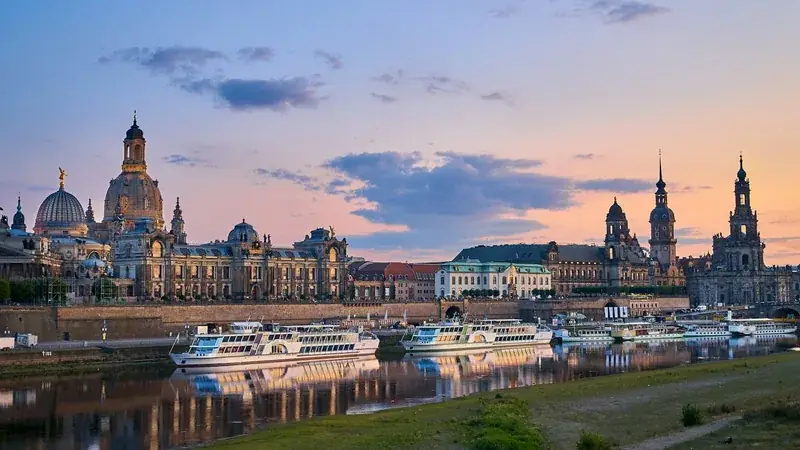

Dresden sits on both banks of the Elbe, and the skyline you see from the river is the one Augustus the Strong set out to build. The Saxon elector, who became King of Poland in 1697, drew architects, painters and musicians to his court, and most of the Baroque landmarks that earned the city its nickname "Florence on the Elbe" date from his reign and his son's. On the night of 13 February 1945 that inner city was largely destroyed in a single raid; what stands today is the result of a decades-long rebuilding that only finished its most famous chapter in 2005.
That double history, splendour and loss and return, is what makes Dresden a city to explore with self-guided audio guides rather than a map alone. Nearly every façade has a second story underneath the first. The Frauenkirche is the clearest example: its dome dominates the Neumarkt today, but the church lay in ruins for almost fifty years before a reconstruction that began in 1994 and was completed in 2005, a year before Dresden's 800th anniversary. The audio guide for the church tells that story before you step inside.

The Zwinger and Theaterplatz
A few minutes' walk west, the Dresden Zwinger is Augustus the Strong's showpiece: built as an orangery and court festival ground, it is now a ring of pavilions and galleries around a vast courtyard. It houses the Old Masters Picture Gallery, the Mathematisch-Physikalischer Salon and the Porcelain Collection, and the audio guide helps you read the sculpture-crowded pavilions as the stage set they were meant to be. Next door on Theaterplatz stands the Semperoper Dresden, Gottfried Semper's opera house, rebuilt after a fire in 1869 and again after the war. The square between them is where most visitors first understand why Canaletto wanted to paint this city.
Dresden Zwinger
Baroque palace courtyard of ornate pavilions and galleries, with a carillon of porcelain bells.
Semperoper Dresden
Neo-Renaissance opera house on the Elbe, crowned by a panther quadriga carrying Dionysus.
Theaterplatz
Grand riverside square framed by an opera house, Baroque cathedral and gallery, with a bronze king.
The Residenzschloss and the Procession of Princes
The Residenzschloss was the seat of the Wettin rulers for centuries and now holds the state art collections, including the Historisches Grünes Gewölbe, Augustus the Strong's treasure chamber. On the castle's outer wall along Augustusstraße runs the Fürstenzug, the Procession of Princes: a mural roughly 102 metres long showing 35 margraves, electors, dukes and kings of the House of Wettin. Painted in the 1870s and transferred to about 23,000 Meissen porcelain tiles between 1904 and 1907, it came through the 1945 bombing with only minimal damage, one of the few things in the old town that did.
Residenzschloss
Rebuilt royal palace housing the Green Vault treasuries, armoury and the electors' founding collections.
Historisches Grünes Gewölbe
Baroque treasury of mirrored rooms where gems, gold and bronzes are displayed in the open.
Fürstenzug
Porcelain-tile mural over a hundred metres long showing a mounted procession of Saxon rulers.
Brühl's Terrace and the Canaletto view
Brühl's Terrace is Dresden's riverside promenade, laid out in the 1740s as Count Brühl's private garden on top of the old fortifications and nicknamed the "Balcony of Europe". Legend has it Augustus the Strong left a thumbprint in its balustrade. From here you look across to the Neustadt bank, and from the Neustadt bank you look back at the terrace, the Albertinum and the domes, which is the classic Canaletto view. Cross the Augustus Bridge at dusk and listen to the guide on the way; the whole Baroque front lights up behind you.
Brühl's Terrace
Riverside promenade on old city ramparts, once a minister's private garden, with sweeping Elbe views.
Albertinum
Former arsenal turned art museum, with Romantic-to-contemporary painting, sculpture and a flood-proof art ark.
Augustus Bridge
Nine-arched sandstone-faced river bridge linking the Baroque old town with the Neustadt quarter.
Across the river in the Neustadt
The Neustadt is where Dresden stops being a museum. Past the Golden Rider, the gilded equestrian statue of Augustus the Strong at the end of the bridge, the Äußere Neustadt, largely spared during the GDR years, is the city's bar, café and street-art quarter. Its best-known corner is the Kunsthofpassage Dresden, a chain of themed backyards between Alaunstraße and Görlitzer Straße, where a cascade of funnels and pipes on a blue façade plays music whenever it rains. A short walk away, Pfunds Molkerei is a dairy shop so lavishly lined with hand-painted Art Nouveau tiles that it draws more visitors than customers.
Golden Rider
Gilded hammered-copper equestrian statue of a Saxon elector and Polish king dressed as a Roman Caesar.
Kunsthofpassage Dresden
Artist-designed courtyards with a blue facade of pipes and funnels that turns rainfall into sound.
Pfunds Molkerei
Historic dairy shop lined floor to ceiling with hand-painted tiles, selling cheese and buttermilk.
Upriver to the Blue Wonder and Pillnitz
Follow the Elbe east and the city turns into villas, vineyards and meadows. The Loschwitz Bridge, opened in 1893 and known to everyone as the Blaues Wunder, the Blue Wonder, links the districts of Blasewitz and Loschwitz; near the end of the war an SS unit tried to blow it up, and two locals cut the detonator wires. On the Loschwitz side the Dresden Suspension Railway climbs the slope to a viewpoint over the river. Further upstream, Pillnitz Castle is Augustus the Strong's summer palace, a riverside ensemble whose gardens are as much the point as the buildings.
Loschwitz Bridge
Pier-free steel cantilever bridge of eighteen ninety-three, painted sky blue above the Elbe.
Dresden Suspension Railway
Hanging cable railway from 1901 climbing a steep hillside to a tower with sweeping river-valley views.
Pillnitz Castle
Chinoiserie riverside summer palace with Elbe gondola stairs, landscaped gardens and a royal gondola.
Getting around
The Altstadt is compact and best explored on foot with your audio guide, starting from the Neumarkt. Trams link the old town with the Neustadt in minutes, and for the Blue Wonder and Pillnitz the pleasant option is the riverside path or a paddle steamer from the Terrassenufer. Allow a full day for the Altstadt alone and a second for the river and the Neustadt.