
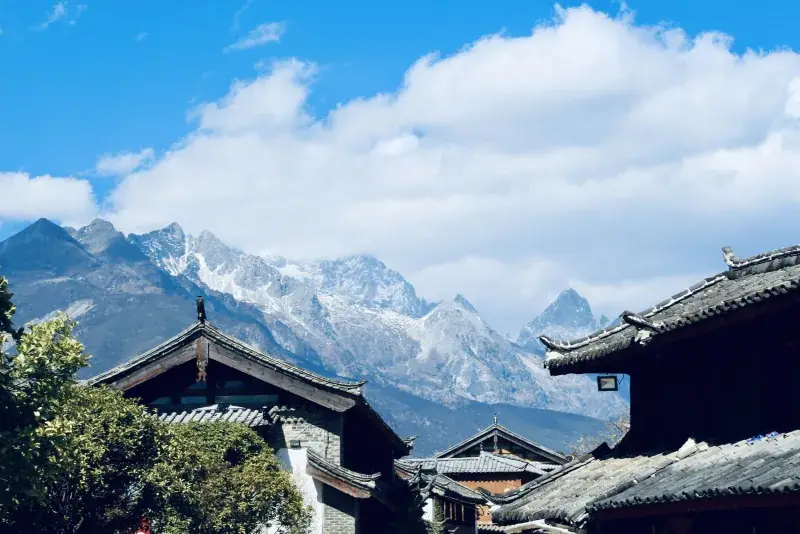

The old town beneath the Jade Dragon
At 2,400 metres in the highlands of northwest Yunnan, Lijiang is the storybook capital of the Naxi people — a maze of cobbled lanes, willow-shaded canals and grey-tiled rooftops that has stood for more than 800 years, with the glaciated wall of Yulong (Jade Dragon) Snow Mountain rising 5,596 metres behind it. The Old Town of Lijiang was inscribed as a UNESCO World Heritage Site in 1997, and it rewards slow, curious wandering: with a self-guided audio tour in your ear, every bridge, courtyard and carved doorway starts to explain itself as you walk.
A trading town with no walls
Lijiang grew rich as a caravan stop on the Tea Horse Road, the mule trail that carried Yunnan tea toward Tibet, and its character is still that of a crossroads — Naxi, Han, Tibetan and Bai influences layered into one town. Famously, it never built city walls: legend says the ruling Mu family refused, because boxing the character for "Mu" inside a wall turns it into the character for "trapped." Instead, three spring-fed streams from Black Dragon Pool thread the town into hundreds of channels crossed by stone bridges — the reason Lijiang is nicknamed the Venice of the East.
The lanes converge on Sifang Street, the old market square where Naxi grandmothers still circle-dance in the evenings. From there, the audio guides lead you up Lion Hill to Wangu Tower for a rooftop-and-snow-mountain panorama, and into the Mu Mansion (Mufu), the chieftains' palace so grand it is called a "mini Forbidden City." Listen for the story of the Dongba script, the Naxi pictographic writing — the only hieroglyphic system still in living use anywhere in the world.
丽江黑龙潭
Ming and Qing pavilions circle a spring-fed pool famed for its mirrored snow-mountain view.
Sifang Street
Tea Horse Road market square flooded nightly by mountain water to wash its stone paving clean.
万古楼
Five-story all-wood pavilion on a hilltop, its sixteen unbroken trunk pillars rising a full thirty-three meters over the old town.
木府
Wood-built compound of courtyards and halls that once ruled a Naxi trading town for centuries.
Beyond the cobblestones
Lijiang is also a base camp for some of China's grandest landscapes, each with its own narrated stop:
- Yulong Snow Mountain and Blue Moon Valley — cable cars climb toward the glacier, above a valley of impossibly turquoise pools.
- Tiger Leaping Gorge — one of the world's deepest river canyons, where the Jinsha (upper Yangtze) thunders between snow peaks.
- Shuhe and Baisha ancient towns — quieter UNESCO-listed siblings of the old town, Baisha famed for its Ming-dynasty murals.
- Lugu Lake — a high alpine lake on the Sichuan border, homeland of the matrilineal Mosuo people.
Come in spring or autumn for clear mountain light, start early before the lanes fill, and let the audio guides turn a pretty stage set back into a living Naxi town.
Blue Moon Valley
Sapphire glacial lakes cupped beneath a snow peak, threaded by waterfalls and mirror-still pools.
Tiger Leaping Gorge
Sheer canyon nearly four thousand meters deep, cut by a roaring river below snow-capped peaks.
Shuhe Ancient Town
Naxi water town whose three-tiered spring wells still ration drinking, washing, and laundry water by gravity alone.
白沙古镇
Century-old herbal clinic where a self-styled celebrity doctor greeted travelers with folk remedies and free tea.
Lugu Lake
Alpine lake where matrilineal Mosuo villages still keep the walking-marriage tradition alive.