
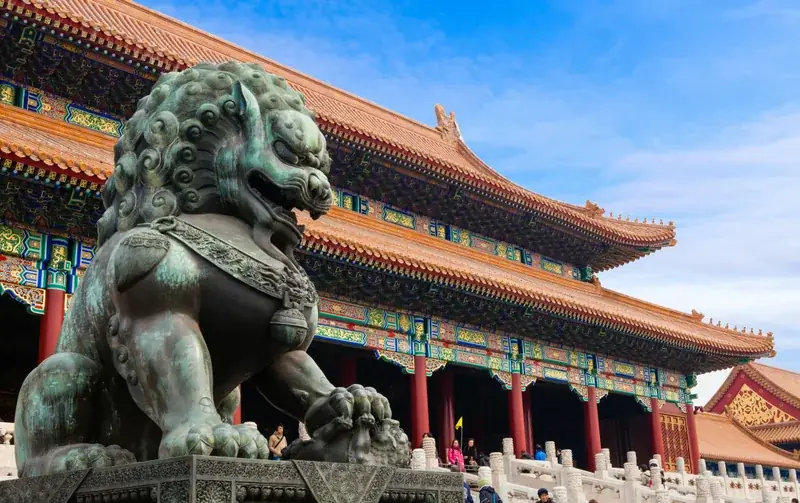

Few cities carry their history as visibly as Beijing. China's capital of more than 21 million people rests on over three thousand years of recorded history, arranged around a ceremonial Central Axis so significant that UNESCO inscribed it in its own right — one of eight World Heritage designations in and around the city. It is a place best explored at your own pace, with a self-guided audio tour in your ears turning each gate, hall and alleyway into a story.
An emperor's city
At the heart of it all lies the Forbidden City, the largest preserved wooden palace complex on Earth: some 980 buildings across 72 hectares, home to 24 Ming and Qing emperors for nearly five centuries. An audio guide walks you along its central axis — from the Meridian Gate to the private quarters where dynasties rose and fell — before you climb neighbouring Jingshan Park for the classic panorama over its sea of golden roofs. South of Tiananmen Square, the Temple of Heaven spreads across a park nearly four times the size of the palace; its Hall of Prayer for Good Harvests was raised entirely of wood, without a single nail, for the emperor's solstice rites. To the northwest, the Summer Palace pairs Kunming Lake with the 728-metre Long Corridor and its 14,000 painted scenes.
Forbidden City
Vast Ming-dynasty imperial palace of golden-roofed halls and courtyards, home to twenty-four emperors over five centuries.
Jingshan Park
Man-made hill of five peaks and pavilions built from moat earth, overlooking the old imperial palace.
Temple of Heaven
Circular wooden hall of triple blue-tiled roofs, built without a single nail for imperial harvest prayers.
Summer Palace
Vast imperial garden of a lake and hill, with pavilions, a marble-style boat and covered walkways rebuilt for an empress.
The Wall on your horizon
No visit is complete without the Great Wall of China, and Beijing is its gateway: restored Badaling is the closest and most famous stretch, while wilder Jinshanling rewards hikers with ridgeline watchtowers marching to the horizon. Here the audio guides give the stones their voice — garrisons, beacon fires, and centuries of engineering underfoot.
Great Wall of China
Ming dynasty fortified ridge with densely spaced watchtowers and a rare triple-tower garrison house.
Great Wall of Badaling
Ming-era stone rampart along steep ridgelines, the first fortified stretch ever opened to tourists.
Great Wall, Jinshanling
Ming-era mountain rampart of sixty-seven watchtowers built by homesick soldiers from the south.
Hutongs, temples and new Beijing
Between the monuments runs old Beijing itself: the hutongs, a maze of grey-brick alleys and siheyuan courtyard homes where laundry lines, chess games and bicycle bells still set the rhythm. Wander them toward the incense-clouded Lama Temple, drift past the White Dagoba in Beihai Park, then jump forward a century in the 798 Art District, where a decommissioned factory complex now houses galleries and studios. End the day the local way — crisp Peking duck, dumplings, hot pot — in a city that serves three millennia of history one street, and one story, at a time.
胡同
Maze of narrow Yuan-dynasty lanes and courtyard homes, birthplace of China's last empress.
Lama Temple
Former princely residence turned Tibetan Buddhist monastery, home to a colossal single-tree sandalwood Buddha.
Beihai Park
Sprawling imperial garden lake ringed by pavilions, centered on an islet crowned with a white Tibetan dagoba.
798 Art District
Cold War munitions factory reborn as a sprawling gallery district under Bauhaus sawtooth roofs.