
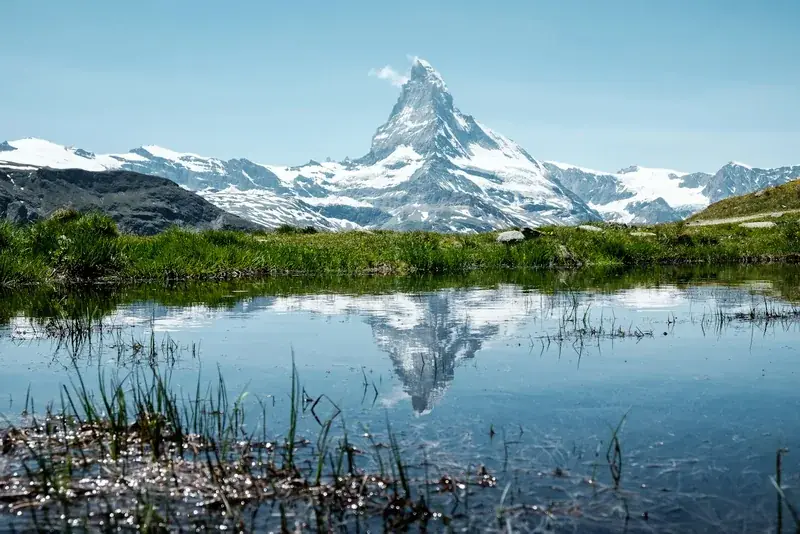
Zermatt is a car-free village at about 1,600 metres in the Swiss canton of Valais, pressed into the head of a valley with one mountain filling the view: the Matterhorn, 4,478 metres of pyramid that has been the symbol of the Alps since a British party first climbed it in 1865. Combustion-engine cars are banned, so the streets hum with small electric taxis and buses, and most visitors arrive by shuttle train from Täsch. Zermatt is also the western end of the Glacier Express to St. Moritz.
What makes Zermatt unusual is how much of its story sits right beside the tourist trail. The hotel where the 1865 climbers met, the church square where four of them are buried, the rope that snapped on the way down: all of it is within a few minutes of the station, and each stop has its own self-guided audio guide so the story unfolds as you stand in front of it. The cable cars and cog railways then take you up to the glaciers, where the guides pick up the geology and the climbing routes.

The Matterhorn and the men of 1865
On 14 July 1865 Edward Whymper and six companions reached the summit by the Hörnli ridge. On the descent the rope broke and four of them, Lord Francis Douglas, Charles Hudson, Douglas Hadow and the Chamonix guide Michel Croz, fell to their deaths; Douglas's body was never found. The expedition had assembled at the Monte Rosa Hotel, whose front wall still carries a plaque to Whymper. Across the way, the Matterhorn Museum – Zermatlantis descends beneath the church square to show how a village of mountain farmers became an alpine resort, with the original snapped rope from that July among its exhibits, alongside a Neolithic stone axe and a lit relief of every route to the summit. The Pfarrkirche St. Mauritius and the Mountaineer's Cemetery beside it hold the graves of climbers lost on the surrounding peaks; the audio guides here tell the individual stories behind the headstones.
Monte Rosa Hotel
Historic alpine hotel where Matterhorn pioneers lodged, with a facade plaque to Edward Whymper.
Matterhorn Museum - Zermatlantis
Underground museum of a rebuilt mountain village, holding the rope that snapped on the first ascent.
Pfarrkirche St. Mauritius
Village parish church consecrated in 1916, with a Noah's Ark ceiling and protected altars and font.
Mountaineer's Cemetery
Churchyard graves of some fifty climbers lost on the surrounding peaks, including Matterhorn pioneers.
Up the Gornergrat
The Gornergrat cog railway opened on 20 August 1898 as the first electric rack railway in Switzerland, and it climbs 9.3 kilometres from the village to 3,089 metres through Riffelalp, Riffelberg and Rotenboden. From the top ridge you look onto the Gorner Glacier and a wall of twenty-eight four-thousand-metre peaks, with the Matterhorn standing apart from them. Get off one stop early at Rotenboden for the Riffelsee, a small lake that mirrors the Matterhorn on still mornings, then walk down to the summit station where the 3100 Kulmhotel Gornergrat lets you sleep at altitude. The railway's history and the view from the terrace are each covered by their own audio guide.
Gornergrat
High rocky ridge reached by a historic rack railway, facing the Matterhorn and a ring of glaciers.
Riffelsee
Small alpine lake on a high ridge where the Matterhorn mirrors perfectly in still morning water.
3100 Kulmhotel Gornergrat
Highest hotel in the Swiss Alps, a stone mountain lodge with sweeping glacier and peak views.
Lakes above Sunnegga
An underground funicular lifts you from the village to Sunnegga, the sunny shelf above Zermatt, and a gondola continues to Blauherd. From there the signposted 5-Seenweg strings together five lakes: the Stellisee, famous for its reflection of the Matterhorn, then Grindjisee, Grünsee, Moosjisee and finally the Leisee, a shallow lake just below Sunnegga where children paddle in summer. It is a half-day walk with the mountain in view almost the whole way.
Sunnegga
Sunny mountain terrace reached by a steep underground funicular, with restaurant and ski runs.
Stellisee
Alpine lake below a mountain inn, framed by cotton grass and ringed by four-thousand-metre peaks.
Leisee
Shallow sunny mountain lake with a bathing beach, playground, picnic spots and Matterhorn views.
Glacier Paradise and the Hörnli side
The cable car to the Matterhorn Glacier Paradise reaches 3,883 metres on the Klein Matterhorn, the highest cable-car station in Europe, with a glacier palace carved into the ice and a viewing platform above the summer ski area. On the way up, the middle station at the Schwarzsee marks the start of the climbers' approach: from the little lake at 2,600 metres the path leads to the Hörnlihütte at 3,260 metres, the hut from which the normal route on the Matterhorn still begins each summer night.
Matterhorn Glacier Paradise
High-alpine summit station tunnelled into a frozen peak, with a lookout over glaciers and the Matterhorn.
Schwarzsee
Dark alpine lake beneath the Matterhorn, with a small pilgrimage chapel to Our Lady of the Snows.
Hörnlihütte
High mountain hut at the foot of the Matterhorn's Hörnli ridge, base camp for summit climbers.
The old village and the hamlets
Behind the busy main street, Hinterdorfstrasse keeps the Zermatt that existed before tourism: dark larch barns and storehouses raised on stone discs to keep the mice out. The same architecture survives in the hamlets on the slopes, Zmutt at 1,936 metres on the way toward the Matterhorn's north face and Findeln at 2,051 metres below Sunnegga, both reached on foot and both with restaurants that are the point of the walk. Downstream of the village, wooden walkways thread the Gorner Gorge, where the glacier river has cut a narrow channel through the rock.
Hinterdorfstrasse
Narrow lanes of blackened larch barns and food stores on stilts, some over five hundred years old.
Zmutt
Centuries-old hamlet of dark wooden houses and a white chapel on a pasture rise below the Matterhorn.
Findeln
Former summer farming hamlet with old chalets and a chapel, now famed for its mountain restaurants.
Gorner Gorge
Narrow serpentinite gorge carved by glacier meltwater, crossed on wooden walkways clinging to the rock.
Getting around
There is no car access: leave the car at Täsch and take the shuttle train, or arrive by rail from Visp or Brig. Inside the village everything is walkable, electric taxis serve the hotels, and the three lift systems, Gornergrat railway, Sunnegga funicular and the Matterhorn Glacier Paradise cable cars, leave from within a few minutes of each other. Summer and winter have separate timetables and some lifts close between seasons, so check before planning a lake walk.