
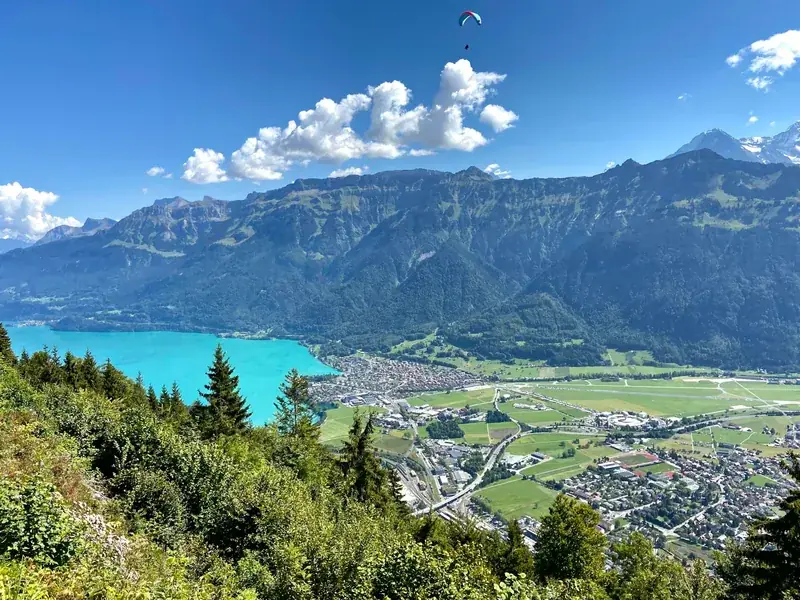
Interlaken takes its name literally: inter lacus, "between the lakes". The town sits on a flat alluvial plain called the Bödeli, with Lake Thun to the west, Lake Brienz to the east and the River Aare threading between them, while the Eiger, Mönch and Jungfrau fill the southern sky. It began as an Augustinian monastery first recorded in 1133, spent centuries as the mill village of Aarmühle, and only took the name Interlaken in 1891 — by which point painters, steamships and the first railways had already turned it into one of Europe's earliest alpine resorts.
Today it is less a destination in itself than the base camp for the whole Bernese Oberland. Most of the sights are a train, boat or cable car away, which is exactly why self-guided audio guides suit the place: you can listen to the story of a hotel on the Höheweg while you wait for a funicular, then pick up the next chapter at a mountain station. The walk between the two railway stations runs along the Höheweg, lined with grand hotels, and past the Höhematte, the open meadow that frames the Jungfrau and where paragliders drift down from the hills above.

Between two lakes
The lakes are the reason the town exists, and they are still the gentlest way to see it. Steamers have run on Lake Thun since 1835 and on Lake Brienz since 1839, and the boats remain part of the public transport network. Lake Brienz is the turquoise one, flanked by steep wooded slopes, with the lakeside village of Iseltwald tucked onto a small peninsula on its southern shore. Lake Thun is broader and softer, dotted with castles along its banks. Either lake works as a half-day on the water with the audio guides telling the story of each stop as the boat pulls in.
Lake Brienz
Turquoise Alpine lake ringed by steep forested slopes, waterfalls and quiet shoreline villages.
Lake Thun
Turquoise Alpine lake ringed by mountains, castles and a legendary dragon-slayer's cave.
Iseltwald
Lakeside fishing village on a peninsula, its wooden pier made famous by a Korean TV drama.
Harder Kulm, the town's balcony
For the overview, ride the Harderbahn funicular up to Harder Kulm, the 1,321-metre summit just north of the town. The ride takes eight minutes, and the observation platform beside the mountain restaurant looks straight down onto Interlaken and the Bödeli, both lakes, and south up the Lütschine valley to the high peaks of the Bernese Alps. It is the best place to understand the geography before you commit to a longer excursion.
Up to the Jungfraujoch
The signature day trip is the Jungfraujoch, the "Top of Europe". Trains from Interlaken climb through Grindelwald or Lauterbrunnen to Kleine Scheidegg, a pass at the foot of the Eiger's north face, where the Jungfrau Railway takes over for the final 50-minute tunnel ride into the mountain. Construction began on 27 July 1896 and took sixteen years; tourists have ridden it since 1912. The station at 3,454 metres is the highest railway station in Europe, and an elevator rises to the Sphinx Observatory at 3,572 metres, looking out over the Aletsch Glacier. Grindelwald itself, in a broad green valley beneath the Eiger, is worth a stop in its own right, and its audio guide covers the village as much as the mountain.
Jungfraujoch - Top of Europe
High alpine saddle with Europe's highest railway station and tunnels blasted through rock.
Kleine Scheidegg
High mountain pass and rail junction facing the Eiger North Face, crowned by a historic inn.
Grindelwald
Alpine glacier village beneath the Eiger, ringed by high meadows, ski slopes and retreating ice.
The Lauterbrunnen valley
South of Interlaken the Lauterbrunnen valley is a deep, glacier-cut trough with waterfalls spilling off its cliffs. The most famous is Staubbach Falls, which drops 297 metres in a single free fall right beside the village — Goethe wrote his poem "Gesang der Geister über den Wassern" while staying nearby. High above the valley's western wall sits Mürren, and above that the Schilthorn, whose revolving restaurant Piz Gloria doubled as Blofeld's lair in the 1969 Bond film On Her Majesty's Secret Service. Lauterbrunnen village is the valley's hub, and an easy place to start a listening tour before the cable cars.
Lauterbrunnen
Glacial valley of sheer limestone cliffs and waterfalls, a world magnet for BASE jumpers.
Staubbach Falls
Free-falling waterfall plunging from an overhanging cliff, dissolving into drifting spray and rainbows.
Schilthorn - Piz Gloria
Revolving summit restaurant with Eiger, Mönch and Jungfrau views and a James Bond film legacy.
The monastery town and Unterseen
Interlaken's own history hides in plain sight behind the hotels. The Reformed Castle Church stands on the site of the medieval Augustinian convent that Bern secularised in 1528, and the adjoining New Castle was built in 1746–50 over the monastery's west wing. Across the Aare, Unterseen is the older, quieter twin, a village laid out in 1279–80 whose Reformed church and timbered square still feel like a small Bernese town rather than a resort. The audio guides for both churches pick up the story that the Höheweg's grand façades tend to overshadow.
Getting around
Interlaken has two main stations, Ost and West, roughly a twenty-minute walk apart along the Höheweg. Trains to Grindelwald and Lauterbrunnen leave from Ost; boats on Lake Brienz dock beside Ost and those on Lake Thun beside West. A regional travel pass covers most trains, boats and many cable cars, and the mountain railways run year-round, though summer gives you the fullest timetable and the open hiking trails.