
Sofia is the capital of Bulgaria and one of Europe's oldest cities, yet it rarely feels like one. Rome conquered it in 29 BC as Serdica, Constantine the Great reportedly called it "my Rome", the Ottomans ruled it for five centuries, and it became Bulgaria's capital only in 1879, when it was a town of barely twelve thousand people. Today about 1.2 million people live here, under the wall of Vitosha mountain that closes off the southern horizon, and the city still sits on forty-nine mineral and thermal springs.
What makes Sofia so good to explore with self-guided audio guides is how tightly those layers overlap. A Roman street surfaces in a metro underpass, a fourth-century rotunda hides inside a courtyard, a mosque and a synagogue stand a few minutes from an Orthodox cathedral, and the stories behind them are easy to miss without someone to tell them. Pick a landmark, press play, and the city starts to explain itself.
Start at Alexander Nevsky Cathedral
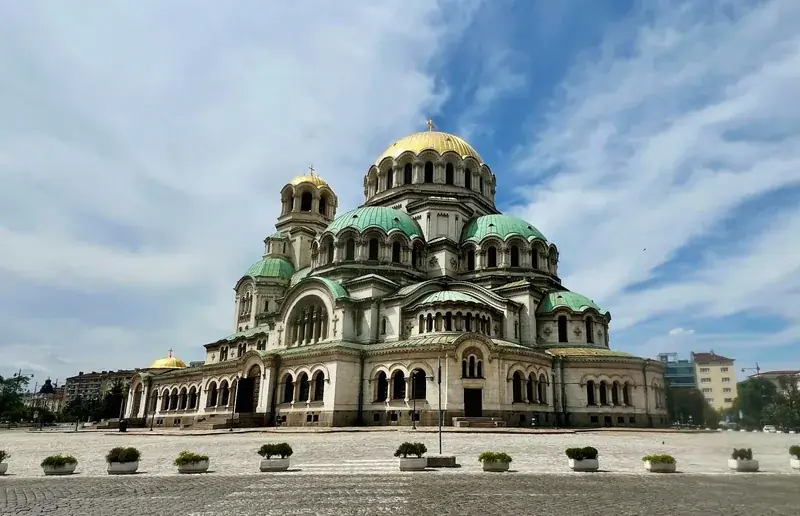
Every visit begins at the Patriarchal Cathedral St. Alexander Nevsky, the gold-domed monument that honours the Russian soldiers who died in the war of 1877 to 1878 that freed Bulgaria from Ottoman rule. The foundation stone was laid in 1882, the building was finished in 1912, and it holds up to five thousand worshippers under a central dome forty-five metres high; twelve bells weighing about twenty-three tons ring from the tower. Its audio guide walks you from the square into the dim, candlelit nave, and down to the Alexander Nevsky Crypt Icon museum, which holds one of the richest collections of Orthodox icons anywhere. Across the square, the plain red-brick St. Sofia Basilica is the sixth-century church that eventually gave the city its name.
Patriarchal Cathedral St. Alexander Nevsky
Neo-Byzantine memorial cathedral with a gilded dome, honouring soldiers of the 1877–78 liberation war.
Alexander Nevsky Crypt Icon museum
Cathedral crypt museum of Orthodox icons, fresco fragments and church plate from the fourth century on.
St. Sofia Basilica
Early Christian brick basilica whose name the capital took, with a revered poet's grave behind its altar.
Roman Serdica under the Largo
Sofia keeps its antiquity underfoot. In the courtyard behind the Presidency stands the Sofia Church of St. George, a brick rotunda from the early fourth century and the oldest standing building in the city. Around it, the Ancient Serdica Cultural Complex opens the excavated streets, walls and houses of the Roman town, uncovered during the construction of the metro and now laid out between the government buildings of the Largo; a Roman amphitheatre, the largest found in Bulgaria, was discovered nearby only in 2004. In the underpass beside the metro station, the tiny half-buried Medieval orthodox temple of St. Petka Samardjiyska shows how Christians built low and quiet under Ottoman rule. The audio guides here do the time travel for you, standing on the same stones.
Sofia Church of St. George
Fourth-century red-brick rotunda with layered medieval frescoes and a ring of painted prophets in its dome.
Ancient Serdica Cultural Complex
Excavated Roman streets and buildings displayed in situ beside a metro station, open to the sky.
Medieval orthodox temple of St. Petka Samardjiyska
Half-buried medieval chapel of the saddlers' guild, with a crypt and centuries of layered murals.
The Square of Tolerance
A few minutes west, four faiths share one neighbourhood, a cluster locals call the triangle of religious tolerance. The Sofia mosque - Banya Bashi, completed in 1566 and the city's only working mosque, faces the mineral baths; the Central Synagogue of Sofia is one of the largest Sephardic synagogues in Europe; and the Cathedral Saint Nedelia anchors the square where the main boulevards meet. Round it off with the Central Market Hall of Sofia, the 1911 covered market that sits between the mosque and the synagogue.
Sofia mosque - Banya Bashi
Sixteenth-century Ottoman mosque of stone and brick bands, built over steaming natural hot springs.
Central Synagogue of Sofia
Moorish-Revival Sephardic synagogue with a vast brass chandelier under a soaring central dome.
Cathedral Saint Nedelia
Domed Orthodox cathedral rebuilt after a 1925 bombing, keeping its surviving gilded iconostasis.
Central Market Hall of Sofia
Neo-Renaissance covered market from 1911 with a three-faced clock tower and Roman ruins below.
Vitosha Boulevard and the city's gardens
From St. Nedelya, pedestrian Vitosha Boulevard runs straight at the mountain it is named after, lined with cafés and the terraces where Sofia spends its evenings. Turn east instead for The City Garden, the oldest park in the capital, with the Ivan Vazov National Theater closing its far side in a swirl of cream and gold. Beyond the university and the Tsar Liberator monument begins Borisova Gradina Park, laid out in 1884 and still the city's favourite place to run, row and sit under the trees.
Vitosha Boulevard
Pedestrian shopping avenue of cafés, 1930s-style lamps and kiosks, aimed at a mountain skyline.
The City Garden
Oldest public park in the centre, with chess players and a view of the National Theatre.
Ivan Vazov National Theater
Neoclassical Viennese-designed playhouse facing a city park, home to the country's oldest stage company.
Borisova Gradina Park
Sprawling historic park of shaded alleys, lakes, a rose garden and towering century-old trees.
Boyana Church and the mountain
Save a half day for the southern edge of the city. In the villa suburb of Boyana, the small medieval Boyana Church holds frescoes painted in 1259, eighty-nine scenes and some two hundred and forty figures, including the portraits of its patrons Kaloyan and Desislava that are among the most lifelike faces in medieval European art; UNESCO listed it in 1979, and its audio guide tells you what to look for in the few minutes visitors are allowed inside. Above it rises Vitosha Nature Park, the oldest nature park in the Balkans, with trails that lead from the city's last tram stop up to Cherni Vrah, the summit at 2,290 metres, with Sofia spread out below.
Boyana Church
Small medieval church with lifelike 1259 frescoes and donor portraits at the foot of Vitosha.
Vitosha Nature Park
Mountain nature park of forests, high peaks and long rivers of lichen-gilded boulders.
Cherni Vrah
Highest summit of Vitosha, with a weather station, rescue post and sweeping views over the capital.
Getting around
Sofia's centre is compact: most landmarks in the first four sections lie within a twenty-minute walk of the Serdica metro station. The metro links the airport, the centre and the foot of Vitosha, and trams and buses cover the rest. For Boyana and the mountain, take a bus or a short taxi ride, and allow time for the queue at Boyana Church, where entry is in small groups.