
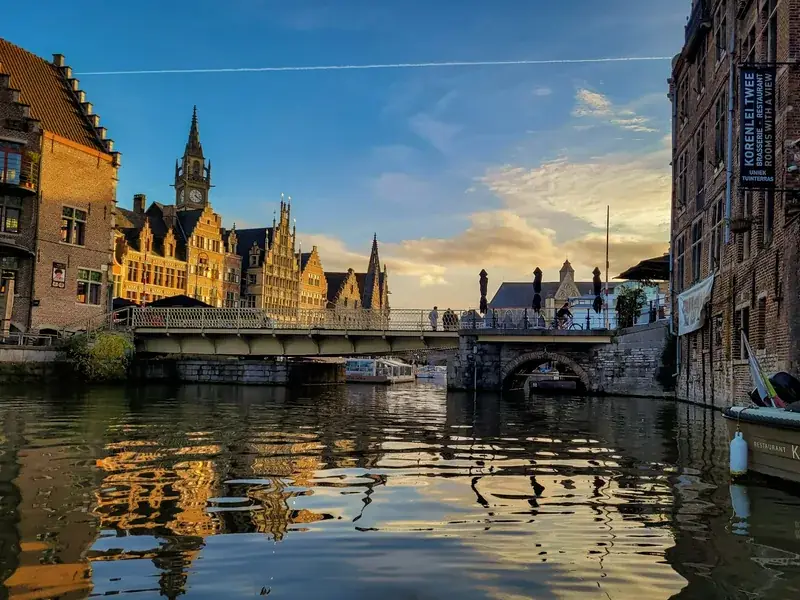

Ghent is the Flemish city that Bruges' crowds walk past, and it rewards those who stop. In the thirteenth century it was the leading woollen-cloth town in Europe, with some 65,000 people inside its walls, the largest city north of the Alps after Paris, and that medieval wealth is still standing: three Gothic towers in a row, a moated castle in the middle of town, guild houses mirrored in the river Leie. Charles V, the Holy Roman Emperor, was born here in 1500. Yet Ghent is no museum piece. A university founded in 1816 keeps the bars full, the car-free centre hums with bicycles and trams, and every July the ten-day Gentse Feesten pulls well over a million people into the squares.
It is also a city built for exploring with self-guided audio guides. Almost everything worth seeing sits within a fifteen-minute walk of St Michael's Bridge, and the best way to meet it is to stand on that bridge, look east along the Leie to where St Nicholas' Church, the Belfry and St Bavo's Cathedral line up in a single frame, and let the story of each tower play as you walk toward it.

The three towers: St Nicholas', the Belfry and St Bavo's
The skyline is a short walk, tower to tower. St Nicholas' Church, built in the local blue-grey Tournai stone, was the merchants' church beside the old grain market. Behind it rises the Belfry of Ghent, begun in 1313 as a watchtower and strongroom for the city's charters, now a UNESCO World Heritage Site with a gilded dragon on top and the old alarm bell Roland, which cracked in 1914, displayed inside. The audio guide tells how the bells once ran the life of the city; the climb, or the lift most of the way up, gives you the view back over the rooftops.
The row ends at St Bavo's Cathedral, home to the Van Eyck brothers' Adoration of the Mystic Lamb of 1432, a painting that has survived iconoclasts, thieves and a wartime rescue from the Nazis. Entry to the cathedral is free; the altarpiece itself is a timed ticket, so book ahead. Restoration of the upper panels continues until 2027, with the originals on show at the Museum of Fine Arts and replicas in the cathedral meanwhile.
St Nicholas' Church
Scheldt Gothic church of blue-grey Tournai stone with a lantern crossing tower and Cavaillé-Coll organ.
Belfry of Ghent
Medieval bell tower crowned by a gilded dragon, with a carillon and sweeping rooftop views.
St Bavo's Cathedral
Gothic cathedral with a Rococo pulpit of oak, gold and marble, and centuries of Flemish art inside.
The Castle of the Counts and the Patershol
Few cities keep a full fortress in their centre. The Castle of the Counts, the Gravensteen, was begun in 1180 and housed the Counts of Flanders until 1353, then served as mint, court and prison, and was very nearly demolished before the city restored it. Its moat and walls are almost intact, and the roof is one of the best lookouts in Ghent. It stands on Sint-Veerleplein, the little square where executions once drew crowds and where the boats now tie up.
Just behind the castle, the Patershol is a tangle of cobbled lanes and brick houses that was a working quarter for centuries and is now where Ghent eats. Save it for the evening and the local waterzooi, a creamy chicken or fish stew.
Castle of the Counts
Moated twelfth-century stone fortress of the Counts of Flanders, later a mint, prison and cotton mill.
Sint-Veerleplein
Cobbled square facing a medieval castle, fronted by a baroque fish-market gate crowned by Neptune.
Patershol
Maze of narrow old brick lanes, once a slum, now packed with restaurants and a summer festival.
Graslei, Korenlei and the old port
The heart of medieval Ghent was its river harbour. The Graslei and the Korenlei face each other across the Leie, one lined with guild houses from the city's grain trade, the other with a mix of Gothic, Renaissance and Baroque facades. This is where the canal boats depart and where the whole city gathers on warm evenings. A few steps upstream, the long brick Groot Vleeshuis was the medieval meat hall; it now sells East Flemish produce under its timber roof, and the audio guide explains why the butchers were kept under one roof in the first place.
Graslei
Medieval quay of guild houses spanning five centuries, from Romanesque grain store to Baroque gables.
Korenlei
Riverside quay of stepped gables and guild houses, once a medieval grain harbour on the Leie.
Groot Vleeshuis
Gothic covered meat market of the butchers' guild, with a rediscovered fifteenth-century chapel mural.
Vrijdagmarkt and the graffiti street
The Vrijdagmarkt has held a market since the twelfth century, and still does every Friday. The statue in the middle is Jacob van Artevelde, the fourteenth-century merchant who led the city through a trade war with England; this square saw the guild battles and proclamations that made Ghent famously hard to rule. A short walk away, the giant red bombard known as Dulle Griet, Mad Meg, has been parked by the water since the fifteenth century. Then cut through Werregarenstraat, the narrow alley that the city made a legal canvas for street artists in the 1990s: the murals change every few weeks, so no two visits look the same.
Vrijdagmarkt
Historic market square ringed by guild houses, centred on a bronze statue of a medieval rebel leader.
Dulle Griet
Giant red wrought-iron bombard from the fifteenth century, forged from iron bars bound with rings.
Werregarenstraat
Narrow car-free alley where every wall is layered in ever-changing graffiti and spray-can art.
Museums in the Citadelpark and the STAM
South of the centre, the leafy Citadelpark holds two museums side by side. The Museum voor Schone Kunsten is Belgium's oldest public art museum, with Bosch, Bruegel, Rubens, Ensor and Magritte, and a glass-walled studio where the Van Eyck restorers work. Across the path, SMAK holds the country's most important collection of contemporary art, from Pop Art to Conceptualism. Towards the station, the STAM city museum lays the whole story of Ghent out on a giant aerial map you can walk across, a good first or last stop for making sense of everything you have heard.
Museum voor Schone Kunsten
Fine arts museum spanning Flemish Primitives to modern art, with a disputed Bosch crowded with faces.
SMAK - Municipal Museum of Contemporary Art
Contemporary art museum in a former casino wing, holding post-war works by Beuys and Belgian artists.
STAM - Ghent City Museum
City history museum in a medieval abbey, tracing wool wealth, revolts and an emperor's revenge.
Getting around
Ghent is about an hour by train from Brussels Airport and half an hour from Bruges or Antwerp. Trains arrive at Gent-Sint-Pieters Station, from where trams 1 and 2 run to the centre in ten minutes. Once there, leave the tram behind: the historic core is pedestrianised and compact, and every landmark above is within easy reach on foot or by bike, with an audio guide playing in your ear.