

Antwerp is Belgium's largest city and one of Europe's great port towns, sitting on the River Scheldt about an hour's train ride from Brussels. In the first half of the sixteenth century it was the second-largest city in Europe north of the Alps and, in the historian Fernand Braudel's words, "the centre of the entire international economy". That Golden Age money paid for the cathedral spire, the printing houses, the guild halls and the painter who still defines the city: Peter Paul Rubens. Today Antwerp layers a diamond-trading quarter, a world-famous fashion school and a reinvented dockland on top of its medieval core, and it is compact enough to explore on your own, with a self-guided audio guide telling each landmark's story as you reach it.
Most visitors arrive at Antwerpen-Centraal, a Beaux-Arts railway cathedral that is regularly ranked among the most beautiful stations in Europe. Step out, let the audio guide explain the dome and the iron train shed, and then walk down the Meir toward the old town.

Start at the Grote Markt and the Cathedral
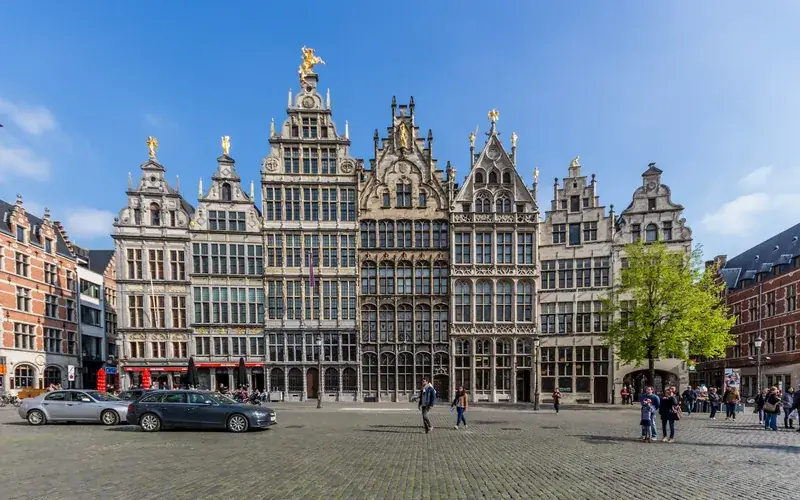
The Grote Markt is Antwerp's living room: a triangular square framed by sixteenth-century guild houses with gilded gables, the Renaissance Antwerp City Hall, and the Brabo Fountain, where a bronze soldier hurls a severed hand into the air. The legend has it that the Roman soldier Brabo cut off the hand of the giant Druon Antigoon, who had been extorting tolls on the river, and threw it into the Scheldt, giving the city its name from "hand-werpen", hand-throwing. The audio guide tells the tale and why linguists doubt it.
A block away rises the Cathedral of Our Lady. Begun in 1352 and never fully finished, it has one completed tower of 123 metres, a belfry on the UNESCO World Heritage list since 1999, and, inside, Rubens's The Raising of the Cross and The Descent from the Cross, two of the most dramatic altarpieces in northern Europe.
Grote Markt
Historic market square ringed by gabled guild houses and a Renaissance town hall with arcaded shops.
Brabo Fountain
Bronze fountain of a legendary hero hurling a giant's severed hand, rising from rocks before the town hall.
Antwerp City Hall
Renaissance town hall with a stone arcade, tiered central bay and statues, built over Roman-era remains.
Cathedral of Our Lady
Soaring Gothic cathedral where craft guilds once kept altars, beside a legendary wrought-iron well.
Rubens and the Golden Age
Rubens was not just a painter here; he was a diplomat, a collector and the owner of a palatial house and studio at the Wapper. The Rubenshuis preserves that Italianate home, its portico and courtyard garden, and the audio guide walks you through how a workshop turned out hundreds of canvases for the courts of Europe. A few streets away, the Plantin-Moretus Museum is the sixteenth-century home and print shop of Antwerp's first great publishing dynasty and the only museum in the city on the UNESCO World Heritage list, with the world's oldest surviving printing presses, a Gutenberg Bible and the first Dutch dictionary. The Handelsbeurs nearby stands on the site of the exchange that opened in 1531, often called the world's first purpose-built commodity exchange, and is a reminder of what the printing and painting were built on.
Rubenshuis
Painter's Italianate palazzo and studio with a Baroque stone portico and formal garden pavilion.
Plantin-Moretus Museum
Renaissance printing house and family home holding the two oldest surviving printing presses in the world.
Handelsbeurs Antwerpen
Arcaded Gothic-revival trading hall under a glass roof, modelled on a sixteenth-century merchant bourse.
Het Eilandje and the river
North of the old town, the Eilandje docklands have become Antwerp's new cultural waterfront. The MAS, the Museum aan de Stroom, is a stacked tower of red sandstone and curved glass that holds the city's history collections and offers a free rooftop panorama over the port, which is the second largest in Europe after Rotterdam. Beside the old quays, the Red Star Line Museum occupies the shipping company's former warehouses and tells how roughly two million emigrants passed through Antwerp between 1873 and 1934 on their way to North America; it is one of the most moving stops on any audio tour of the city. Back on the river bank, Het Steen is the oldest building in Antwerp, a stone fortress that now serves as the city's visitor centre and the best place to understand why the Scheldt made everything else possible.
MAS - Museum aan de Stroom
Spiral museum tower of hand-cut red Indian sandstone and frameless wavy glass above old harbour docks.
Red Star Line Museum
Restored harbour sheds where emigrants were inspected and disinfected before sailing to America.
Het Steen
Medieval riverside fortress gatehouse with a former prison, modern visitor wing and Scheldt views.
Zuid, fashion and the Meir
South of the centre, the Zuid district gathers the city's art. The KMSKA, the Royal Museum of Fine Arts, reopened after a long renovation with Flemish Primitives, Rubens and James Ensor under one roof. Antwerp's other great export is fashion: the Antwerp Six, among them Dries Van Noten and Ann Demeulemeester, put the city on the world style map in the 1980s, and the MoMu fashion museum in the Nationalestraat quarter explains how a small Flemish city came to dress the runways. The Meir, the long pedestrian shopping street between the station and the old town, is where locals actually buy their clothes, lined with eighteenth- and nineteenth-century facades and the Rococo Palace on the Meir.
KMSKA - Royal Museum of Fine Arts Antwerp
Grand fine arts museum of Flemish masters, from fifteenth-century altarpieces onward.
MoMu - Antwerp Fashion Museum
Fashion museum in a restored 1890s building, sharing its home with a renowned fashion academy.
Meir
Grand pedestrian shopping boulevard lined with rococo mansions and a gilded festival-hall arcade.
Zurenborg's Art Nouveau streets
For a different Antwerp, ride a short way southeast to Zurenborg. Around the Cogels-Osylei, a late nineteenth-century speculative suburb turned into an open-air architecture museum: Art Nouveau, Gothic Revival, Neo-Renaissance, Greek Revival and even Tudor-style villas stand side by side, many with mosaics and sgraffito above the doors. The audio guide points out the details you would otherwise walk straight past.
Getting around
The historic centre, the Eilandje and Zuid are all walkable, and trams and buses connect them to the station and Zurenborg. To see the skyline the way sailors did, take the wooden escalators down into the Sint-Anna's Tunnel, a 572-metre pedestrian and cycle tunnel under the Scheldt opened in 1933, and cross to the left bank for the classic view of the cathedral spire above the quays.