
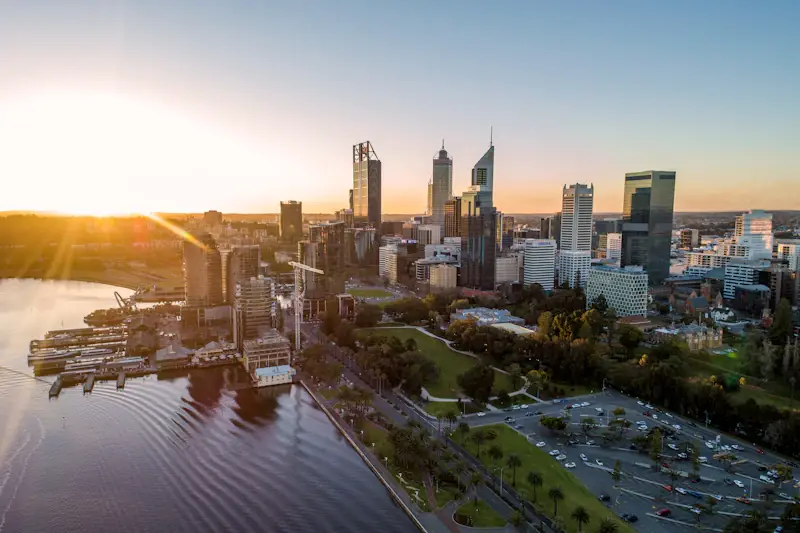
Perth is Australia's sunniest capital and one of the most isolated big cities on Earth: the nearest city of any size, Adelaide, is more than 2,100 km away, and Jakarta is closer than Sydney. That distance shaped a place that feels unhurried and outward-looking at once — a glassy skyline on the Swan River (Derbarl Yerrigan to the Whadjuk Noongar people, whose country this has been for at least 48,000 years), a port town with convict walls down the river, and an island of smiling marsupials just offshore.
Founded in 1829 as the capital of the Swan River Colony, Perth wears its history lightly. The stories are here — gold rushes, convict labour, wartime gun batteries — but they are spread across a river, a coastline and a hill rather than packed into one old town. That is exactly why it suits a self-guided audio tour: each landmark has its own guide that fills in what the view alone does not say, and you move between them at the pace of the city — by ferry, by bike, by a long walk along the water.
Kings Park and the view from Mount Eliza
Start where Perth starts for most locals: Kings Park and Botanic Garden, one of the largest inner-city parks in the world, on the bluff the Noongar call Kaarta Koomba. The Western Australian Botanic Garden displays more than 3,000 species of the state's native flora, and the lemon-scented gums along Fraser Avenue frame the classic view of the skyline and the river. The State War Memorial sits at the edge of the escarpment, and the Lotterywest Federation Walkway lifts you into the eucalyptus canopy on a glass-and-steel bridge. The audio guides here cover both the memorial's story and the Noongar meaning of the hill, so the view comes with context.
Kings Park and Botanic Garden
Riverside parkland and botanic garden with bushland trails and a transplanted giant boab tree.
State War Memorial
Granite obelisk and undercroft roll of honour on a hilltop, overlooking the city it commemorates.
Lotterywest Federation Walkway
Rusted-steel and glass boardwalk arcing through treetop canopy to a bridge over a river valley.
Elizabeth Quay and the Swan River foreshore
Below the park, the city meets its river at Elizabeth Quay, the waterfront precinct that reconnected the CBD with the water in the 2010s. The Bell Tower rises beside it, housing the bells of St Martin-in-the-Fields from London — a curious gift that the guide explains better than the plaque does. From the quay, the foreshore path runs east toward Matagarup Bridge, whose arches sweep across to Optus Stadium; walk it at dusk when the river turns silver and the afternoon sea breeze, the famous Fremantle Doctor, arrives on cue.
Elizabeth Quay
Waterfront promenade around a reflooded river inlet, ringed by restaurants, bars and a rooftop lookout.
The Bell Tower
Copper-and-glass campanile housing eighteen full-circle bells rung in shifting mathematical sequences.
Matagarup Bridge
Suspension footbridge with soaring swan-shaped steel arches and a river-spanning climb deck.
Gold, mint and arcades in the old city centre
Perth's central grid holds a compact set of nineteenth-century survivors. The Perth Mint has been pouring gold since 1899 and still does a live pour for visitors. A few blocks away, Perth Town Hall is the only convict-built town hall in Australia, and London Court is a 1937 mock-Tudor arcade that looks several centuries older than it is. These are short walks apart, and the guides stitch them into one story of a frontier town made rich by gold.
The Perth Mint
Heritage-listed mint with a nineteenth-century melting house and live gold-pour demonstrations.
Perth Town Hall
Gothic-style civic hall of red brick, raised by convict labour and marked with hangman's-rope and broad-arrow carvings.
London Court
Half-timbered Tudor arcade with mechanical jousting-knight clocks and boutique cafes.
Northbridge and the Perth Cultural Centre
Cross the railway line and the mood changes. Northbridge was Perth's Little Italy and is now its nightlife and dining quarter, anchored by the Perth Cultural Centre. Here WA Museum Boola Bardip tells the story of Western Australia from its deep Aboriginal past to the present, and the Art Gallery of Western Australia holds one of the country's best collections of Indigenous art. Listen to the guides before you go in; they set up what to look for.
Northbridge
Live-music bar in a converted shopfront, launchpad for local bands that went on to global stages.
WA Museum Boola Bardip
State museum wing housing a guarded case of coins salvaged from a Dutch trading-ship mutiny.
The Art Gallery of Western Australia | AGWA
Brutalist state art gallery spanning colonial masterpieces to contemporary Aboriginal works.
Fremantle: convicts, markets and the harbour
Half an hour down the river by train, Fremantle (Walyalup) is the port that Perth was built to serve. Fremantle Prison, built by convicts in the early 1850s and in use until 1991, is Western Australia's only World Heritage-listed building; its tunnels and torchlight tours are the highlight, and the audio guide tells the grim and occasionally absurd stories behind the limestone walls. Fremantle Markets have traded since 1897 under a Victorian hall, and the Round House on Arthur Head, the colony's first permanent building, still fires a time gun at one o'clock.
Fremantle Prison
Convict-built limestone prison with reinforced cells once meant to hold an escape artist.
Fremantle Markets
Federation Romanesque produce hall of eighteen ninety-eight, still trading fresh food and crafts under one heritage-listed roof.
The Round House
Twelve-sided limestone jail above the harbour, once a lockup for prisoners bound for a penal island.
Rottnest Island and the beaches
Eighteen kilometres off Fremantle lies Rottnest Island — Wadjemup — a car-free, 19-square-kilometre island of white bays that Willem de Vlamingh called a paradise on earth in 1696, naming it after the quokkas he mistook for rats. Cycle between beaches, climb to the Oliver Hill Battery and its two 9.2-inch Second World War guns, and let the guide tell the harder history too: the island was an Aboriginal prison from 1838 to 1931. Back on the mainland, Cottesloe Beach is the city's classic sunset strip, with Norfolk pines and Indian Ocean water that stays warm into autumn.
Rottnest Island
Former Aboriginal punitive prison island whose limestone quod cells later served as holiday lodging.
Oliver Hill Battery
World War Two coastal gun emplacement with underground tunnels and a heritage railway up the hill.
Cottesloe Beach
Wide crescent of white sand with a rocky groyne, turquoise shallows and one of the city's most watched sunsets.
Getting around
Perth is easy. Free CAT buses loop the CBD, Fremantle and Northbridge; trains reach Fremantle in about thirty minutes; and ferries cross from Elizabeth Quay to South Perth and from Fremantle or the city to Rottnest. Most of the central landmarks are walkable, so download the guides, pick a shoreline, and start listening.