
Yerevan wears its 2,800 years lightly. Founded in 782 BC as the Urartian fortress of Erebuni — a cuneiform inscription unearthed on Arin Berd hill in 1950 still records King Argishti I's decree — the Armenian capital is older than Rome, yet its center hums like one continuous open-air café. Built largely of rose-colored volcanic tuff that glows warmest at sunset, the "Pink City" is best understood story by story, and that is exactly how a self-guided audio tour unlocks it: wander at your own pace while each landmark tells you how an ancient fortress town became the beating heart of the Armenian world.

A capital drawn in pink stone
Modern Yerevan follows the 1924 master plan of architect Alexander Tamanian, who wrapped wide, café-lined boulevards around a graceful circular core. Its showpiece is Republic Square, an ensemble of pink-and-cream tuff façades raised between 1926 and 1941, where the "singing fountains" light up summer evenings — the square's audio guide traces how Tamanian's vision reshaped the old Persian-era town. A short stroll north, past the 1933 Opera House, the Cascade climbs its 572 limestone steps studded with fountains and bold contemporary sculpture from the Cafesjian Center for the Arts, and rewards you at the top with the classic panorama of Mount Ararat floating above the rooftops.
Republic Square
Grand tuff-stone plaza ringed by hand-carved neoclassical government buildings around musical fountains.
Yerevan Cascade
Soviet-era stone staircase of fountains and terraces, revived as an open-air sculpture museum.
Armenian National Opera and Ballet Theatre
Grand neoclassical opera house overlooking an artificial lake shaped like a miniature Sevan.
Manuscripts and memory
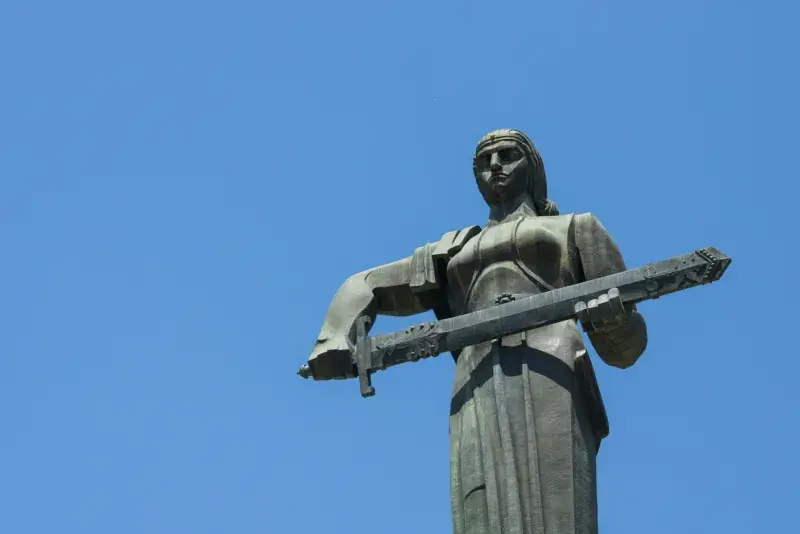
Yerevan holds the deep archive of a nation. The Matenadaran guards more than 23,000 ancient manuscripts, from illuminated Gospels to medieval science, while on a quiet hill across the Hrazdan gorge the Tsitsernakaberd memorial — a 44-meter stele and eternal flame raised in 1967 — keeps vigil for the victims of the Armenian Genocide, its museum telling the story with unflinching care. From Victory Park, the colossal Mother Armenia monument watches over the city, sword in hand; listen to her story and you hear the story of Soviet and independent Armenia in one sweep.
Matenadaran
Repository of ancient illuminated manuscripts, its facade lined with basalt statues of the scholars who wrote them.
Tsitsernakaberd Armenian Genocide Memorial Complex
Hillside memorial of twelve inward-leaning basalt slabs circling an eternal flame, with a soaring split stele beyond.
Mother Armenia Monument
Bronze giant on a Soviet pedestal, sword ready, gazing west toward Mount Ararat.
Beyond the boulevards
Some of Armenia's greatest treasures sit within an easy day trip, each with its own narrated story: the Hellenistic colonnade of Garni temple, the rock-hewn chapels of Geghard monastery, and Holy Etchmiadzin, mother cathedral of the world's oldest state church.
Garni temple
Basalt Hellenistic-style temple of a first-century king, collapsed by earthquake and rebuilt stone by stone in the nineteen seventies.
Geghard
Chapels, tombs and cells carved directly out of a solid cliff, prized for acoustics that turn a single voice into a choir.
Holy Etchmiadzin - Armenian Apostolic Holy Church
Fourth-century cathedral marking the spot where the founder of Armenian Christianity saw a vision of the divine descending to earth.
Coffee, brandy, conversation
Between landmarks, do as Yerevantsis do: linger over thick Armenian coffee, browse the weekend Vernissage craft market, and toast the evening with the brandy that made the city famous. In Yerevan, listening comes naturally — the stones here have been talking for twenty-eight centuries.